
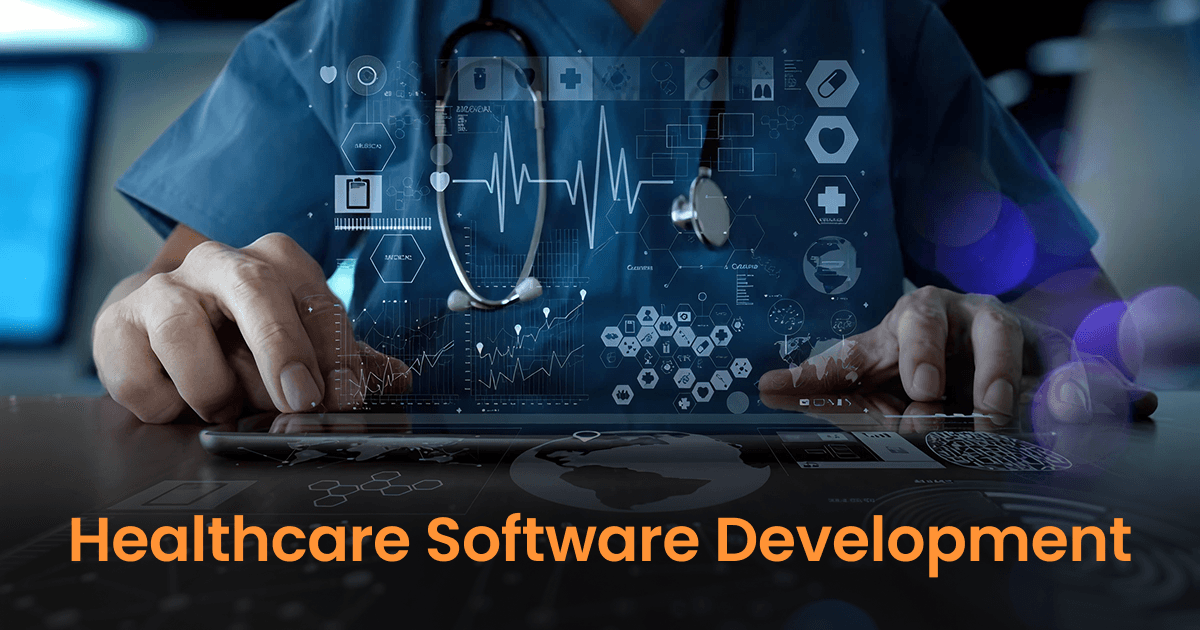
In the era of technology, every industry is evolving to provide fast and accessible services to its customers and users. The healthcare sector is also transforming to provide digital medical care to patients located anywhere in the world. Considering the digital revolution of the healthcare sector, it's the right time for the startups to act fast. Healthcare software development is not just about integrating APIs and coding an app but resolving human problems in a most reliable and efficient way.
If you’re an early stage innovator or a startup founder, looking for telehealth software solutions, you’re at the right place. This guide will walk you through the entire step-by-step process of healthcare application development from selecting an idea to regulatory compliance.
HealthTech Market: Understanding the Statistics and Potential Growth
The healthcare sector is evolving with cutting-edge technologies, such as cloud computing, robotics, artificial intelligence, block chain, and more. With the growing demand of telehealth, MedTech companies are likely to invest more into medical software development and modern patient care solutions, such as remote patient monitoring, AI-enabled diagnostic tools, and electronic health records (EHRs). Global Market Insights claimed that the size of the digital health market is expected to rise over $981.5 billion by 2032. Moreover, Dimension Market Research reported that the market of healthcare SaaS platforms will rise from $36.8 billion in 2024 to $93.4 billion by 2033. These statistics demonstrated fundamental growth and shift in the healthcare sector.
Insurance companies, doctors, and medical researchers are looking for healthcare IT solutions to improve operational efficiency, reduce costs, and overall medical care delivery. Such IT solutions include both custom-built and off-the-shelf that delivers security, scalability, and real-time data access. Additionally, machine learning and artificial intelligence are helping healthcare providers in making informed decisions, automate administrative tasks, and identify diagnostic tasks that once required the entire department to operate. Healthcare startups can take full advantage of this opportunity to develop ready-to-opt custom healthcare software to stay ahead in the pool of competitors.
Significant Healthcare Software Development Services for Startups
Telehealth software solutions include a wide range of solutions designed to meet the needs of clinics, hospitals, insurers, and startups. Here are the major categories of healthcare IT solutions to develop the understanding how they build and how your startup can integrate them to stay ahead of market competitors:
EHR and EMR
Electronic health records (EHR) and electronic medical records (EMR) are tailored to manage clinical documentation, such as diagnosis, medical histories, treatments, allergies, imaging data, and lab results. EHR are specific for interoperability across organizations while EMR are often restricted to single practice. Startups can implement EHR to improve capacities like data analytics, visualisation, or informed decision-making.
Telehealth and Telemedicine
These tools are specifically designed to enable remote communications between patients and medical professionals. Telemedicine involves the distant diagnosis and treatment of a patient while telehealth refers to preventive care, monitoring, and education. Today, these tools are providing asynchronous and synchronous communication combined with appointment scheduling, e-prescription generation, and
patient education.
Digital Billing and RCM
Revenue Cycle Management (RCM) Software manages the entire journey of a patient. The tasks usually include medical billing, claim processing, collections, and insurance verification. These can be integrated with AI/ML to enhance performance, such as detecting anomalies and predicting errors or denials. Startups, looking to reduce administrative burden through automation and who can optimize the reimbursement can take advantage of these tools.
RPM Solutions
Remote patient monitoring (RPM) solutions are tailored to track patient vitals via connected devices, such as glucose monitors, blood pressure cuffs, or wearables. Such tools provide real-time data to medical professionals for proactive intervention. RPM offers a potential business opportunity for startups, especially those who are willing to cater chronic condition management.
mHealth App Development
Such applications assist patients in monitoring vitals, accessing health records, managing medications, and interacting with medical professionals. These days insurance companies and hospitals are partnering with startups to offer medical apps that help with medication schedule adherence, fitness track, and medical care ( like heart rate, breaths count, and BP regulations) navigation.
Patient Portal and Interaction Systems
Such systems provide patients with access to intake forms, medical records, lab results, and reminders. Tools combined with PMS and EHR offer more cleaner UX and adaptability. Startups can design platforms or mobile first solutions focused on patient experience that can plug into clinical systems.
Healthcare Software Development: A Step-by-step Process
The process of developing healthcare software development is not similar to consumer apps. Here is the complete process of software development for healthcare startups to follow:
Step 1 - Strategic Planning and Validation
Collaborate with clinical stakeholders because 90% of hospitals rely on fewer software systems for operations. Key points to consider:
Start with analysis of the clinical workflow followed by gap identification in existing solutions.
Identify FDA requirements and compliance regulations. Also, determine payment methods exist for your selected solution.
After choosing a healthcare business model, focus on your target market, development timeline, and funding possibilities.
Step 2 - Technical Infrastructure and Compliance Planning
The cloud architecture of your healthcare business model should be based on HIPAA-compliant infrastructure, such as Google cloud healthcare, AWS BAA, Azure healthcare. Use database strategy to separate the non-PHI data from PHI data with access controls and encryption. API design should be with FHIR compatibility for any future interactions. Design security framework with role-based access controls.
Step 3 - Minimum Viable Product Development and Integration
For core security framework, use HIPAA compliance before feature development. To develop the essential clinical features, prioritise the minimum viable clinical workflow. To validate the design, use a major EHR system. Make a mobile foundation with responsive design and native app planning.
Step 4 - Clinical Assessment and Testing
Testing healthcare software is not like a typical software QA. For clinical validation, you will test clinical workflows, regulatory compliance, and patient safety scenarios as well. To clinically validate the solution, use real scenarios and discuss the results with medical experts. For security penetration, conduct third-party assessment with medical expertise. To check the performance, implement peak loads, such as emergency situations and telehealth spikes. Perform independent auditing to check the HIPAA compliance before launch of the solution.
Step 5 - Test Launch and Market Validation
Launch the healthcare solution with limited pilot to validate the technical performance, clinical workflows, and business model assumptions. Furthermore, test the product with 2-3 different hospital profiles. Assess the success criteria of it in financial, clinical, and operational matters. Perform the regular check-ins with clinical administrators and users.
Final Thoughts
Telehealth software solutions are not the supporting tools for the modern healthcare industry, they are evolving as the backbone of this sector. From remote medical consultations to real-time monitoring and securing patient data, the potential in smart healthcare systems is expanding rapidly. Whether you’re a startup thinking of launching a telehealth product, a healthcare provider looking for a solution to streamline operations, or an individual aiming to revolutionise the healthcare sector with innovative healthcare products, custom healthcare software could be a good starting point. The success of the product highly depends on selecting the right technology, compliance with regulations, user-centric design, and experienced development teams.